§ 2.7section 7 of 20·~9 min
Testing with pytest
Why test?
Without tests, every change means clicking through the program by hand to check that nothing broke, so people stop checking. A test is a small function that runs your code and asserts the result is what you expect. pytest finds and runs all of them in a second.
Evals for LLM apps (Week 19) are tests too. The habit you build now is the one AI teams hire for.
Your first tests
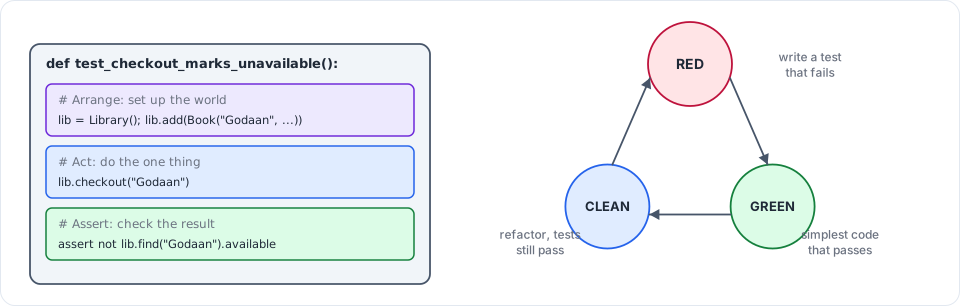
Figure 2.3: Every test has three parts (arrange, act, assert). Work in a loop: write a failing test, make it pass, then clean up.
# tests/test_library.py
import pytest
from library import Library, Book, Member, BookNotAvailableError
@pytest.fixture
def lib() -> Library:
"""A fresh library for EVERY test that asks for it."""
lib = Library()
lib.add_book(Book("1", "Wings of Fire", "A.P.J. Abdul Kalam"))
lib.add_member(Member("M1", "Asha"))
lib.add_member(Member("M2", "Vikram"))
return lib
def test_issue_marks_book_unavailable(lib):
lib.issue_book("1", "M1")
assert not lib.books["1"].available
assert lib.members["M1"].borrowed == ["1"]
def test_issue_twice_raises(lib):
lib.issue_book("1", "M1")
with pytest.raises(BookNotAvailableError): # passes only if this error is raised
lib.issue_book("1", "M2")
uv add --dev pytest
uv run pytest -q # -q = quiet: dots for passes, F for failures
How it works:
- pytest collects files named
test_*.pyand functions namedtest_*. assert <condition>passes if the condition is true. If it's false, pytest shows both sides so you can see the difference.- A fixture is reusable setup. Naming
libas a parameter tells pytest to call the fixture and pass in the result, fresh for each test, so tests can't affect each other. pytest.raises(SomeError)checks that the code does fail the way it should. Testing the error paths matters as much as testing the happy path.
What to test
For each public method, test:
- The happy path: normal input gives the expected result.